


How it works

The Next-Test Method, one week at a time.

Find where the points went. Train them on the clock. Show you every Sunday.

Get the free 24-Hour Gap Map It starts with one page about your kid's last test.

Why the usual help doesn't move the test

  • Once-a-week tutoring never sees the graded test.
  • Videos and worksheets have no clock and no grader.
  • Office hours re-teach what your kid already knows.

Here's what grading tests has taught us. It's almost never the effort. And it's usually not what they know.

AP tests take points for things homework never checks:

  • The reason behind the answer, written out.
  • The work, shown step by step.
  • Finishing with the clock running.

So the homework says A. The test says 68. Then the test stays at school, nobody sees the mistakes, and the next test grades the same gap.

Step one: the diagnostic

It starts with one test.

A 45-minute session, just your kid and a live AP tutor. No parents, no pitch. Your kid holds the pen the whole time.

  1. 1

    It opens with what they already do right.

    Every kid has points they earn every time. They hear that first.

  2. 2

    A short timed set from the unit just tested.

    Plus the last test, if it came home. On the clock, the way the test felt.

  3. 3

    One question, graded the College Board way.

    The missing step shown, then the question redone right. They watch that question go from points lost to points earned.

  4. 4

    Then a short call with you, and the page.

    Later that day, we walk you through what we found. Within 24 hours, the page is yours: where the points went, the score the test could have been, and a dated plan for the next test, with the marked test.

What's on the page

24-Hour Gap Map

A.R. · AP Chemistry · Unit 3 test · 71/100 · written Oct 7

Where the points went

  1. 1. Setup. Q4, Q7. Right answer, no work shown. 5 points.
  2. 2. The “because.” Q9. Right conclusion, no reasoning written. 3 points.
  3. 3. Time. Q12–⁠13 left blank. 6 points.

Points, by cause

Setup 5
Reasoning 3
Time 6

29 points lost. 14 of them on chemistry already known.

This test could have been 85

Worked example

Q9 as written: 1 of 4. Q9 with the reasoning: 4 of 4.

Next test: Thursday, Oct 29

  • Each week until then: 2 timed sets, setup written out every time
  • Monday, Oct 26: a short mock, timed like the test
  • Every “explain” question: write the “because”
  • Leave alone: Lewis structures (already solid)

To May, in five milestones

Test 1Semester gradeDecember mockMarch mockMay exam

Fight or drop: fight. The chemistry is there; the points are recoverable.

Written within 24 hours of the diagnostic.
The first 14 days, so you know it's working

Parents give a tutor about two weeks. So do we. Here's what you'll have seen by then.

  1. Day 0

    You join on the call.

    You pick a fixed time slot that's open: Mon/Thu, Tue/Fri or Wed/Sat.

  2. Within 24 hours

    Your welcome.

    Your login details, your fixed session link, and one person to message: your Family Success Manager.

  3. Week one

    The first two sessions.

    No “getting to know you” hour. Session one starts on the class and the next test.

  4. By day 7

    The first graded answer.

    On your phone, with the points before and after. If your kid isn't engaging by now, we tell you first.

  5. Day 14

    You've seen it from the inside.

    The first Sunday reports are in. Until today, one message gets you a full refund.

Every week, on your kid's own class

Two private sessions. Practice graded by the next day. Help at 9pm. Five lines on Sunday.

How a unit runs

Over a unit, the sessions move from re-teaching the hard parts, to exam-style practice graded together, to a short mock before the test, to a look at the test after it comes back: what earned points, what didn't, and what changes.

Your kid holds the pen

Every session is live and 1-on-1, on exam-style problems. Your kid does the work. The tutor shows where the points are, and every session is recorded for you to watch.

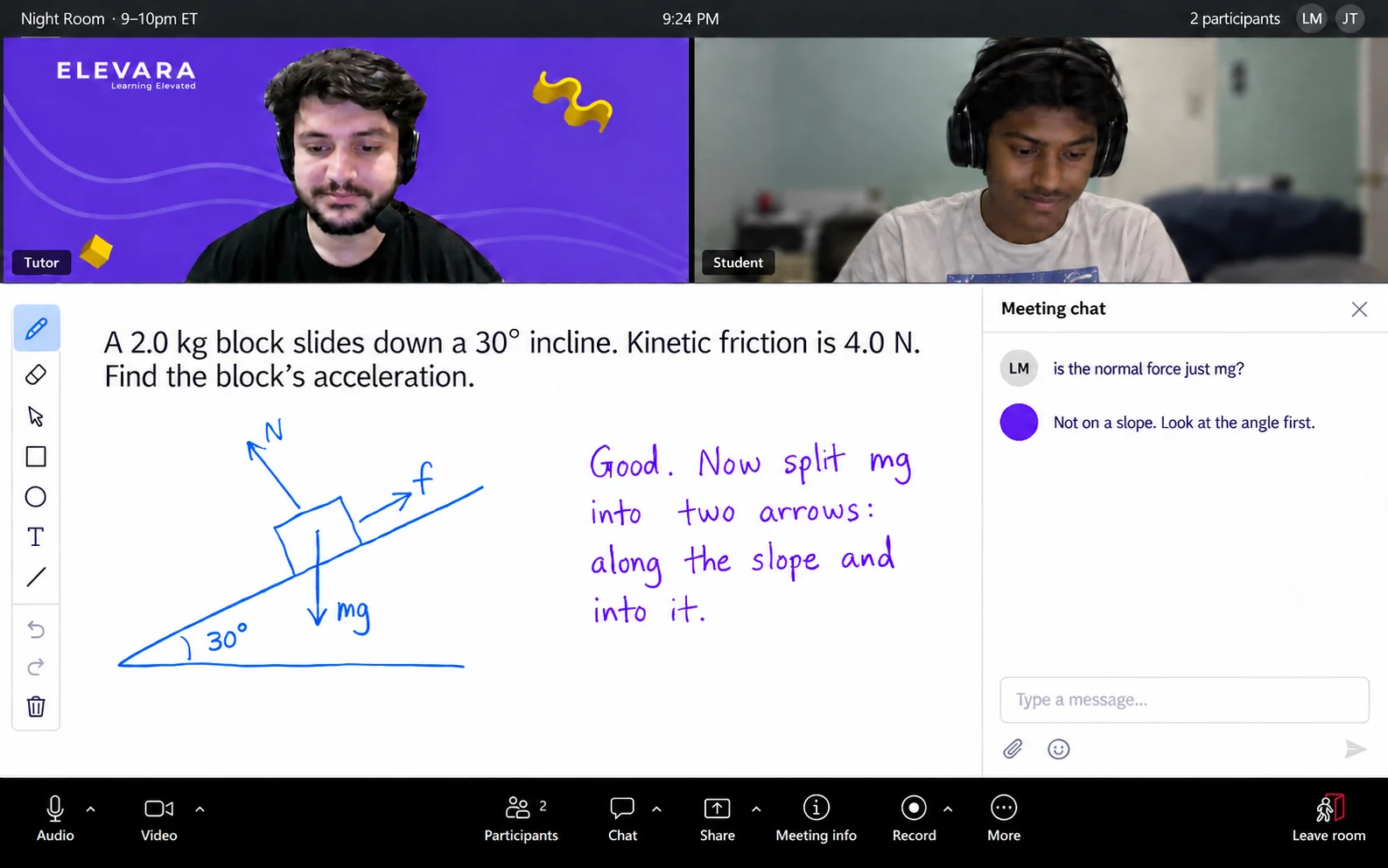
The Night Room: 9–⁠10pm ET, Monday to Saturday.

Between sessions, nobody is alone with the homework.

The Night Room. A live AP tutor in an open online room, 9–⁠10pm ET, Monday to Saturday. Drop in, no appointment, no extra charge.

The Stuck Line. Outside the room, a photo of the problem on WhatsApp. The same day or the next working day, a short walkthrough or a step-by-step guide for that step comes back.

In the room, the tutor asks questions until your kid finds the step. The walkthrough or guide shows the method, then your kid finishes the problem. We never do the homework for them.

Around every test

The test should never be the first time on the clock.

72 hours before

A short mock on the clock, built like the teacher's test.

every test

When a test needs more

If we think your kid needs an extra session before a test, we add one, free. You don't have to ask.

when needed

After it comes back

We go through it at the next session: what earned points, what didn't, and what changes before the next one.

every test

December and March

Full mock exams, graded the College Board way, with a projected AP score.

twice a year

What you see, and what your kid does

You see

  • The Gap Report, before you pay anything.
  • Five lines on your phone every Sunday.
  • A 30-minute monthly progress call.
  • Every session, recorded, in your account.
  • One person for every question: your Family Success Manager.

Your kid does

  • Two 50-minute sessions a week, holding the pen.
  • Short timed practice sets, graded by the next day.
  • The Night Room or the Stuck Line, when stuck.
  • A short mock before every test.
  • No extra hours. The practice replaces the hours that weren't working.

See it on your own kid's test first.

Get the free 24-Hour Gap Map One page about your kid's last test, within 24 hours. Free. No card.